MIT Develops Novel 'Bionic Knee' Prosthesis
Researchers at the Massachusetts Institute of Technology (MIT) have made significant strides in prosthetics technology with the development of a new "bionic knee" prosthesis. This innovative device integrates directly with a patient's muscles and bones, offering more natural movement control and enhanced stability.
The new prosthesis is designed to overcome the limitations of traditional prosthetics, which often provide only basic support and lack the ability to replicate the complex movements of a natural knee joint. By using an agonist - antagonist myoneural interface (AMI) and titanium rod implantation, the MIT team has created a system that mimics the body's natural neuromuscular control mechanisms.
The AMI is a key component of the new prosthesis. This surgical technique reconnects pairs of muscles in the residual limb, allowing them to interact dynamically. This interaction not only provides sensory feedback but also generates electrical signals that can be used to control the prosthesis. When one muscle in the pair contracts, the other stretches, sending signals to the nervous system that are then translated into commands for the bionic knee.
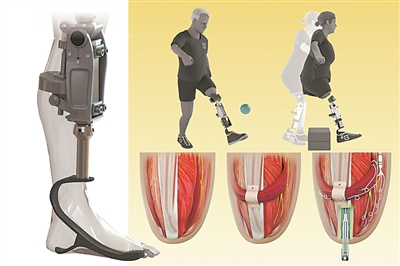
This approach is a departure from traditional amputations, which disrupt the natural communication between muscles. By maintaining this connection, the AMI enables amputees to have a more intuitive sense of how their prosthetic limb is moving, leading to more natural - looking and efficient locomotion.
Titanium Rod ImplantationIn addition to the AMI, the researchers developed a titanium rod implantation technique. The titanium rods are inserted into the residual femur in the amputated leg. This not only improves the mechanical stability and load - bearing capacity of the prosthesis but also serves as a platform for a more advanced neural interface.
The rods are equipped with 16 leads that can pick up signals from the AMI - enabled muscles inside the body. These signals are then transmitted to the prosthesis, allowing for a more precise translation of the patient's muscle movements into the movement of the bionic knee. This integration of the implant with the body's natural structures provides a more stable and responsive connection, reducing the risk of slippage or misalignment that can occur with traditional socket - based prosthetics.
The combination of the AMI and titanium rod implantation has shown promising results in initial testing. Patients using the new bionic knee prosthesis were able to perform a variety of tasks more easily compared to those using traditional prosthetics. They could walk at a faster pace, with the ability to adjust their speed more naturally. Additionally, activities such as climbing stairs and navigating obstacles, which are often challenging for amputees, became more manageable.
In laboratory tests, subjects with the new prosthesis demonstrated better control over knee flexion and extension. They were able to adapt more quickly to changes in terrain, such as slopes or uneven surfaces. The enhanced stability provided by the direct skeletal connection also reduced the risk of falls, which is a common concern among amputees using traditional prosthetics.
While the current results are encouraging, the research is still in an early stage. The team at MIT plans to conduct further studies, including long - term trials in a larger number of patients. They also aim to optimize the technology to make it more widely available and affordable.
Future research will focus on refining the neural interface to provide even more detailed control over the prosthesis. There are also plans to integrate additional sensors into the system, such as those that can detect pressure, temperature, or vibration, to further enhance the user's sense of touch and environmental awareness.
Overall, this new bionic knee prosthesis represents a significant step forward in prosthetics technology. By integrating directly with the body's muscles and bones, it offers a more natural and functional solution for amputees, potentially improving their quality of life and mobility.